This circuit alerts us when there is a fire accident at home by ringing a siren sound.
You might have seen fire alarms earlier but this is quite different as
it generates a siren sound instead of a buzzer and also it uses basic
components to generate that siren sound.
We are aware that there are many integrated circuits
which can be used to generate the siren effect but we preferred to use
basic electronics components like resistors, capacitors and transistors
to generate it so that you will clearly understand the internal working
of it and it will be much useful for you as you will gain more knowledge
by analyzing it instead of simply going or pre designed integrated
circuits.
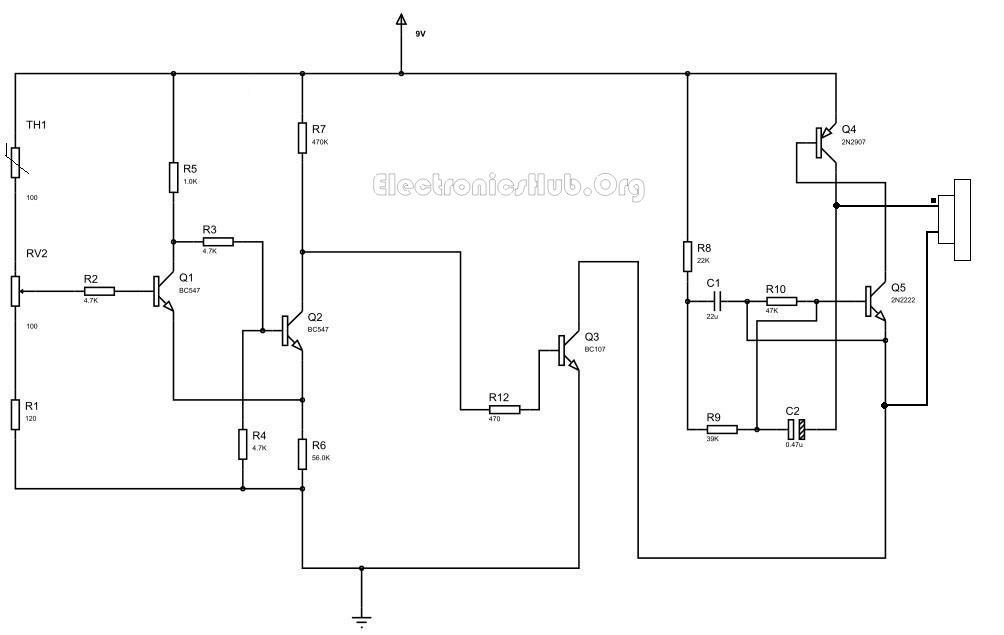
Circuit Diagram of Fire Alarm:
 Description:
This circuit uses a thermistor
to sense the temperature. When it senses that the temperature of the
environment is increasing above a given threshold, then it gives a
signal. The temperature at which the circuit detects fire can be
adjusted by using the potentiometer arrangement at RV2.
When the temperature increases above the set value, the potentiometer arrangement produces a high voltage. This voltage is then given to BC547 transistor in common emitter mode. It is an NPN general purpose transistor.
When the base is given a high input, it gets turned on. When the
transistor is turned on, its collector voltage is reduced to low as the
collector to emitter voltage decreases. The collector output voltage of
the first transistor is given to the base as an input to the second BC
547 NPN transistor. This transistor too is in common emitter mode and as
the input is low when the temperature threshold is reached, the output
at the collector will rise high. In this state, it will turn on the next
transistor, i.e BC107. This transistor will now act as a switch for the
siren circuit. This transistor can bear power quite larger than the
BC547 and it is also equipped with a heat sink for that purpose.
When the BC107 transistor turns on, it allows current to pass from power supply
to ground through collector thereby acting as an electronically
controlled switch. When the current is passing, the siren circuit which
is assembled as the load to the circuit is turned ON. Then you can hear
the siren sound through the buzzer. The capacitors used in the circuit
are the main components in producing the siren effect. The principle
involved in generating the siren effect is to make an oscillator with an
envelope which periodically increases and decreases so as to generate
that effect.
contact:
DEV HARSHA
whatsapp,hike nd calls
8978511693 & 9505630317
contact:
DEV HARSHA
whatsapp,hike nd calls
8978511693 & 9505630317
Comments