Introduction to Motion Detector:
The motion detector is not only used as intruder alarm but also used in many applications like home automation system,
energy efficiency system, etc. The motion detector will detect the
motion of the people or objects and give the appropriate output
according to the circuit. In general, motion detector uses different
types of sensors like Passive infrared sensor (which will detect the
motion of the person using the person body heat), microwave sensor
(Microwave sensor will detect the motion of person by measuring the
change in frequency from the produced beam), ultrasonic sensor (It
produces acoustic signals which will detect the motion of a person) etc.
There are some motion detectors which will use different technology
and include number of sensors (PIR, microwave sensor, ultrasonic sensor,
etc.) to reduce the false triggering and increase the accuracy in
motion detection.
Here is the simple and reliable circuit which uses IR sensor for transmitting the IR beam and photo transistor
for receiving the IR beam. If there is any disturbance or interference
in between the transmitting and receiving of the beam, it will justify
that there is an intrusion and makes the alert through alarm. This is
circuit is easy to construct and cost of circuit is very low when
compared to normal motion detector.
Block Diagram of Motion Detector:
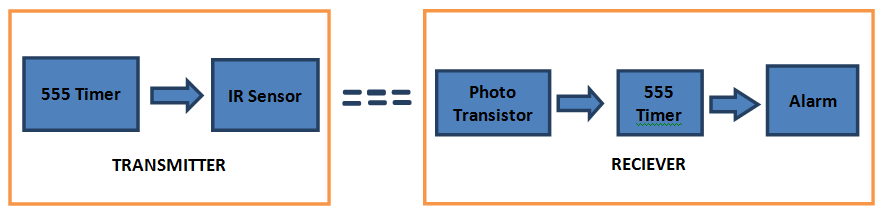
IR sensor will produce the high frequency
beam which is projected on the photo transistor with the help of
555timer at the transmitter. When this high frequency beam has got any
interruption, the photo transistor will trigger the 555 timer of
receiver section and gives alert through the alarm.
Motion Detector Circuit Diagram:
Motion Detector Circuit Explanation:
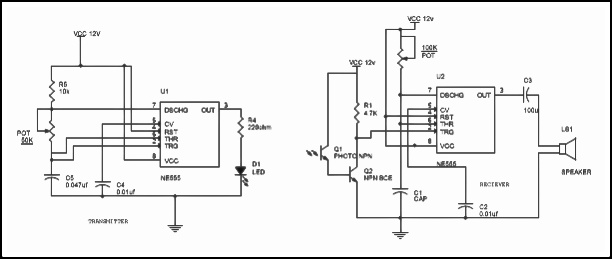
- The IR sensor will make the high frequency beam of 5 kHz with the help of 555timer which is set to astable multivibrator mode at the transmitter section.
- The IR sensor will produce the high frequency beam which is received by the photo resistor at the receiver section. This frequency will be in one phase when there is no interruption between the IR sensor and photo transistor. Total circuit will not give any output in this phase. When there is an interruption between IR sensor and photo transistor, the beam produced by the IR sensor will be in different phase. This different phase will be immediately detected by the photo resistor and make the 555 timer to give alarm through speaker.
- When there is no intrusion, the photo transistor will make the pin2 high of 555timer which is set in monostable mode, and there will be no output given in this configuration. When there is intrusion, the pin 2 of monostable timer is made low which will make the alarm to alert. The alarm time depends on the capacitor C1 and variable resistor POT.
Main Components in Motion Detector Circuit:
IR sensor: the main concept of IR
sensor is to produce a beam of infrared light (whose wave wavelength is
longer than visible rays and shorter than microwaves, in normal
infrared wave length should be greater than 6µm). IR sensors are based
on three different laws they are planks radiation law, Stephan Boltzmann
law and Wien’s displacement law.
- Planks Radiation Law states that the energy of electromagnetic radiation is confined to indivisible packets (quanta), each of which has energy equal to the product of the Planck constant and the frequency of the radiation (planks constant = 6.62606957 × 10⁻³⁴ m2 kg /s).
- Stephan Boltzmann Law states that total energy radiated per unit on a black body using all wavelengths per unit time J* is directly proportional to the fourth power of the black body’s thermodynamic temperature T:

- Wien’s Displacement Law: the wavelength of maximum emission of any body is inversely proportional to its absolute temperature (measured in Kelvin). As a result, as the temperature rises, the maximum (peak) of the radiant energy shifts toward the shorter wavelength (higher frequency and energy) end of the spectrum.
Peak intensity occurs at this wavelength ƛ =(0.0029 meter.K)/Temperature in Kelvin
In IR sensor the infrared source and
transmission of infrared are two important parts. In infrared source,
there are different sources like black body radiators, tungsten lamps,
silicon carbide in IR sensors. They will use infrared wavelength LED as
infrared source. In transmission media it will be different like air,
optical fiber etc.
Photo Transistor: Photo
transistors are the detectors of IR radiation or any photo radiation.
They will convert this IR radiation into current or voltage.
Applications of Motion Detection:
- Motion detectors can be used as an intruder alarm in home, offices, banks, shopping malls etc.
- They can be used as counting machines, automatic light control etc.
- They can be used in energy efficient systems, home automation system and control systems.
contact:
DEV HARSHA
whatsapp,hike nd calls
8978511693 & 9505630317
Comments