
WIRELESS SWITCH CIRCUIT DIAGRAM

Generally appliances that we used in our home are being controlled with the  help of devices like switches, senors. However sometimes it is dangerous to have physical contact with these switches. So to overcome these dangers, here we have explained a circuit that needs no physical contact with the appliance. In these circuits all you  need is to pass your hand  above LDR. As you first pass your hand over LDR the device connected with  it started and remain in that state till you again pass your hand above LDR.

These circuits are mainly depending on two ICs. First one is LM714 which is an operational amplifier. These IC is used to increase the voltage level at the output hundred  of a thousand times as compared with  the input. Another one is most generally used JK flip flop i.e. CD4027. These IC works in toggle mode and based on the JK flip flop master slave concept. This IC is used to alter the state when the signal is given to the any one of the input terminals and can get more  than single output. There are four input pins in JK flip flop named J and K along with set and reset pin and Q and Q¯ for output.
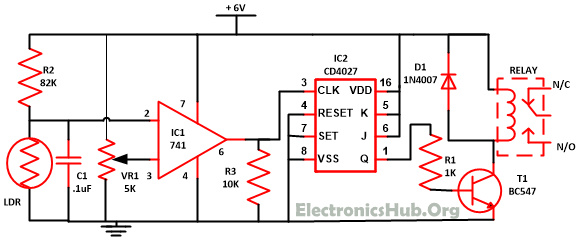
Wireless Switch Circuit Wireless Switch Circuit – ElectronicsHub.Org
Description:
The circuit is made up of Operational amplifier LM741 which is employed like a comparator for sensitive voltage, LDR , Preset VR1 is used to give a reference voltage to the pin 3 which is a non-inverting terminal as well as to LDR and R2 is linked with IC1 at inverting pin 2 along with a few additional components.
It is very simple to understand the working of the circuit. LDR device will not start till we do not  pass our hand over it and as a result of it IC1 pin 2 move to high state. And as a result  of its low state is achieved by the IC1 pin 6 which is an output pin.
Now as soon as  someone passes their hand over LDR, IC1 pin 3 is set to high as compared with the IC1 pin 2 as a result of its pin 6 reaches to high state which supply a clock pulse to 13 pins of IC2 (a flip flop IC). The logic level present at the input terminal ie. J and K guarded the state of a flip flop with the help of some internal control. With the positive going cycle of the clock changes occur. Set and Reset pin are not dependant on the clock and it started when high signal is provided to any one of the input pins.
The circuit revealed is triggered on the primary rim of the switch pulse ie output vary when you once more place your hand above LDR. As in the circuit you can find that J and K both attached to high input which implies that at each transition of the clock pulse whether negative or positive pin 13 fluctuate between high and low. This can be demonstrated with the assist of JK flip flop truth table. Hence when it got the pulse from clock  from IC1 as of hand above LDR transistor attached to pin 15 begins condition and the output  is get  with the help of relay attached in the circuit. With the help of the VR1 sensitivity of LDR can be adjusted.
Components used in this Circuit:
  • IC
  • CD4027 – 1
  • LM741 – 1
  • Resistor
  • R1 (1K) – 1
  • R2 (82K) – 1
  • R3 (10K) – 1
  • VR1 (5K) – 1
  • Relay – 1
  • D1 (1N4007) – 1
  • LDR – 1
  • T1 (BC547) – 1
  • C (. 1uF) – 1uit
                                                                                             for contacts:
                                                                                           cell :  7569146411,
                                                                                email:devaharsha143@gmail.com

Comments

Popular posts from this blog

Fire Alarm Circuit

This circuit alerts us when there is a fire accident at home by ringing a siren sound . You might have seen fire alarms earlier but this is quite different as it generates a siren sound instead of a buzzer and also it uses basic components to generate that siren sound. We are aware that there are many integrated circuits which can be used to generate the siren effect but we preferred to use basic electronics components like resistors, capacitors and transistors to generate it so that you will clearly understand the internal working of it and it will be much useful for you as you will gain more knowledge by analyzing it instead of simply going or pre designed integrated circuits. Circuit Diagram of Fire Alarm: Description: This circuit uses a thermistor to sense the temperature. When it senses that the temperature of the environment is increasing above a given threshold, then it gives a signal. The temperature at which the circuit detects fire can be adjusted ...

LED DIMMER WITH CIRCUIT DIAGRAM

In this circuit, at the starting LED glow slowly, then grown brighter and once again slowly it became dim. The basis of the whole circuit is an operational amplifier IC named LM358. Circuit Diagram of LED Lamp Dimmer: LED Lamp Dimmer Circuit Diagram – ElectronicsHub.Org Working of LED Lamp Dimmer Circuit: LM358 is mainly made up of a package which contains two not dependent operational  amplifiers of high gain. The most significant attribute of these IC is that we have no need of the  independent power supply for the functioning of each comparator till the large range of the power supply. LM358 can be employed like transducer amplifier or can be worked as DC gain block etc. The huge DC voltage gain of the LM358 IC is 100db. For the only power supply this IC can work on the voltage range of 3V to 32V while for the twin power supply this IC work on the range of ±1. 5V to ±16V . And moreover large output voltage is also supported by it. Related Post: PWM L...

mobile jammer with circuit diagram

Simple Mobile Jammer Circuit Diagram: Simple Mobile Jammer Circuit Diagram Cell Phone Jammer Circuit Explanation: If you understand the above circuit, this circuit analysis is simple and easy. For any jammer circuit, remember that there are three main important circuits. When they are combined together, the output of that circuit will work as a jammer. The three circuits are RF amplifier. Voltage controlled oscillator. Tuning circuit. So the transistor Q1, capacitors C4 & C5 and resistor R1 constitute the RF amplifier circuit. This will amplify the signal generated by the tuned circuit. The amplification signal is given to the antenna through C6 capacitor. Capacitor C6 will remove the DC and allow only the AC signal which is transmitted in the air. When the transistor Q1 is turned ON, the tuned circuit at the collector will get turned ON. The tuned circuit consists of capacitor C1 and inductor L1. This tuned circuit will act as an oscillator with zero resi...